Vid celestial inmortal
天仙藤
(活血止痛)
Vid celestial inmortal
-天仙藤 Tiān Xiān Téng
-Dutchman’s Pipe Vine / Northern Dutchman’s Pipe Vine
Medicinal category
Activates blood circulation and relieves pain.
Other names
Dūlín Téng, Sānbǎi Liǎng Yín, Dōulíng Miáo, Mǎdōulíng Téng, Qīng Mùxiāng Téng, Cháng Shā Téng, Xiāng Téng.
English name
Dutchman’s Pipe Vine, Northern Dutchman’s Pipe Vine.
Classical source
Recorded in Bencao Tujing.
Origin
The medicinal material consists of the stems and leaves of plants in the Aristolochiaceae family, mainly Aristolochia debilis Sieb. et Zucc. and Aristolochia contorta Bunge.
Latin botanical name: Aristolochia contorta Bunge.
Harvesting and storage are carried out before the Frost Descent solar term, when leaves begin to fall. The aerial parts are cut, sun-dried, and bundled.
Habitat and distribution
It grows in mountain forests, along streams, roadsides, hillsides, valleys, ditches, and moist shrublands.
It is distributed in Northeast China, North China, and in provinces such as Shaanxi, Gansu, Ningxia, Shandong, Jiangxi, Hubei, Henan, as well as regions south of the Yangtze River.
Botanical description
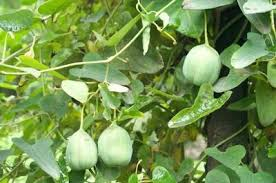
Northern Dutchman’s pipe vine is a herbaceous climbing plant. Leaves are papery with slender petioles; leaf blades are ovate-cordate or triangular-cordate with entire margins and palmate veins. Flowers grow in axillary racemes, with a tubular perianth swollen at the base and extended into a tongue-like limb, usually yellow-green with purple markings. Fruits are six-angled capsules that split open when mature, releasing flat, winged seeds.
Aristolochia debilis has a similar habit, with slightly larger flowers and fruits.
Macroscopic characteristics
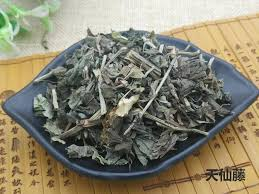
The stems are slender, cylindrical, slightly twisted, 1–3 mm in diameter, yellow-green to yellow-brown, with nodes and ridges. They are brittle and easily broken. Leaves are mostly wrinkled or fragmented, dark green to pale yellow. The odor is mild and aromatic, and the taste is light. Material with thin stems, attached leaves, and green coloration is considered superior.
Chemical constituents
The plant contains aristolochic acid D, magnoflorine, and β-sitosterol. Some sources also report aristolochine in stems and leaves.
Pharmacological actions
Refer to the pharmacological properties described under Aristolochia species.
Processing
Remove impurities, wash off soil, moisten slightly, cut into sections, and dry in the sun.
Meridian affiliation
Liver, Spleen, and Kidney meridians.
Nature and flavor
Bitter in taste and warm in nature.
Precautions
Use with caution in individuals with deficiency conditions.
Classical texts advise against use in cases of qi and blood deficiency.
Functions and indications
Promotes the movement of qi and blood, relieves pain, promotes urination, reduces swelling, and detoxifies.
It is used for stomach pain, hernia pain, edema during pregnancy, postpartum abdominal pain due to blood stasis, and snake or insect bites.
Dosage and administration
For internal use, decoct 6–10 g.
For external use, apply an appropriate amount as a wash or poultice.
Traditional commentaries
Classical physicians described Tianxian Teng as a medicine that promotes circulation of qi and blood and treats various types of pain, pregnancy-related edema, abdominal pain, wind-damp disorders, and chronic cough, emphasizing its ability to unblock stagnation and harmonize circulation.
Additional record (National Compilation of Chinese Herbal Medicines)
The stems and leaves of Aristolochia contorta or Aristolochia debilis are used. They are harvested before leaf fall, dried, and bundled.
Nature and flavor are bitter and warm.
Functions include promoting qi and blood circulation, relieving pain, and promoting urination.
Indications include pregnancy edema, chest and abdominal pain, hernia pain, and rheumatic pain.
Dosage is 1.5–3 qian (approximately 4.5–9 g).
Reference
Recorded in Zhonghua Bencao and National Compilation of Chinese Herbal Medicines.