Rama y hoja de Rhinacanthus
de nariz grande
白鹤灵芝
(杀虫止痒)
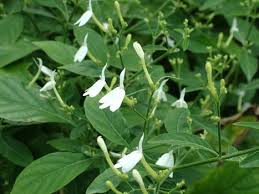

Rama y hoja de Rhinacanthus de nariz grande
-白鹤灵芝 Bái Hè Líng Zhī
-Twig and Leaf of Bignose Rhinacanthus
Pinyin Annotation
Bái Hè Líng Zhī
Alternative Names
Xian Cao
English Name
Twig and Leaf of Bignose Rhinacanthus
Classical Source
This medicinal material is recorded in the Handbook of Commonly Used Chinese Herbal Medicines compiled by the Guangzhou Military Region.
Source
The medicinal material consists of the twigs and leaves of Rhinacanthus nasutus (L.) Kurz, a plant belonging to the Acanthaceae family.
The botanical name is Rhinacanthus nasutus (L.) Kurz.
[Synonyms: Justicia nasuta L.; Rhinacanthus communis Nees]
For harvesting and storage, it is collected in spring and summer, washed clean, and used fresh or dried in the sun.
Habitat and Distribution
It grows in cultivated or wild environments.
It is distributed in Guangdong, Hainan, Guangxi, Yunnan, and other regions of China.
Botanical Description
Rhinacanthus nasutus is a shrub reaching 1–1.5 m in height. Young branches are pubescent. Leaves are opposite with short petioles; the leaf blades are elliptic, 3–7 cm long and 2–3 cm wide, with slightly obtuse to acute apices, cuneate bases, and entire margins. The veins on the lower surface are prominent, and both surfaces are covered with hairs.
The cymose inflorescences are compact, terminal or borne in the upper leaf axils, forming panicle-like clusters. Bracts and bracteoles are minute. The calyx is deeply five-lobed, with linear-lanceolate lobes about 3 mm long, bearing glandular hairs on both surfaces. The corolla is white and salverform, with short glandular hairs externally; the corolla tube is about 2 cm long. The limb is bilabiate: the upper lip is lanceolate, about 8 mm long, with a slightly notched apex, while the lower lip is deeply three-lobed and about 10 mm long.
There are two stamens inserted at the throat of the corolla; the anthers are two-celled and arranged vertically, with filaments about 1 mm long and exserted. The ovary and the lower part of the style are sparsely pubescent. The fruit is an oblong capsule containing two to four seeds, each provided with a hook-like appendage.
Chemical Constituents
The roots contain lupeol, β-sitosterol, stigmasterol, and the glucosides of these sterols, as well as naphthoquinone compounds including rhinacanthin A and B.
The stems and leaves contain naphthopyran-dione compounds such as 3,4-dihydro-3,3-dimethyl-2H-naphtho[2,3-b]pyran-5,10-dione.
Pharmacological Actions
Cytotoxic activity has been demonstrated. Naphthoquinone compounds isolated from the roots, including rhinacanthin A and B, exhibit cytotoxic effects.
Antifungal activity is significant. A naphthopyran derivative extracted from the leaves and stems, namely 3,4-dihydro-3,3-dimethyl-2H-naphtho[2,3-b]pyran-5,10-dione, shows strong antifungal activity against the rice blast pathogen Pyricularia oryzae. Its ED₅₀ is 0.4 × 10⁻⁶ (0.4 ppm). At a concentration of 100 ppm, the inhibition rate of spore germination reaches 82.3%.
Meridian Tropism
Lung meridian.
Nature and Flavor
Sweet and slightly bitter in taste, slightly cold in nature.
Functions and Indications
It clears heat and moistens the lungs, kills parasites, and relieves itching.
It is used for consumptive cough, scabies, ringworm, and eczema.
Dosage and Administration
For internal use, it is decocted in water at a dose of 10–15 g; when fresh material is used, the dosage may be doubled.
For external use, an appropriate amount of fresh material is crushed and applied to the affected area.
Reference
Zhong Hua Ben Cao